An accessible unit is the right choice any time the public is invited or a crew member needs one — block parties, church festivals, 5Ks, weddings in a park, and longer construction jobs where a wheelchair user may be…
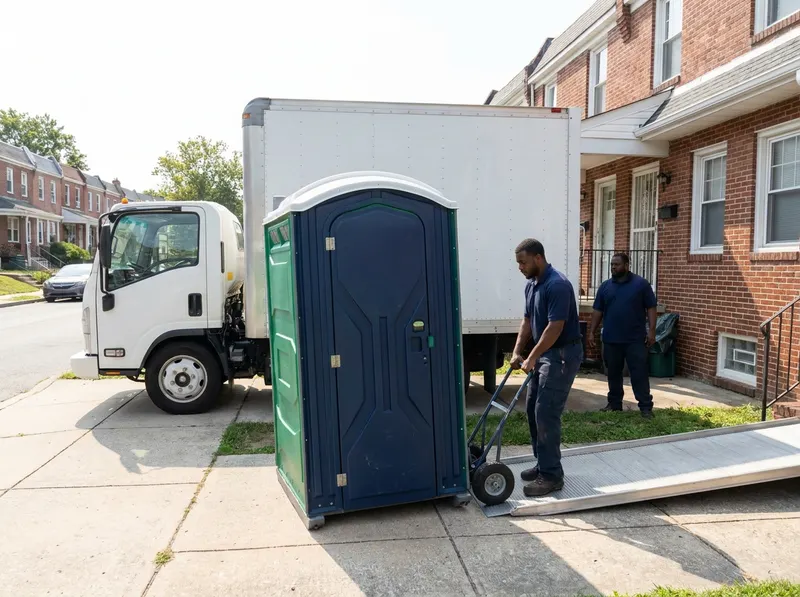
An accessible unit is the right choice any time the public is invited or a crew member needs one — block parties, church festivals, 5Ks, weddings in a park, and longer construction jobs where a wheelchair user may be on site. The trade-off is footprint. A standard unit occupies roughly 4 feet by 4 feet; an accessible unit needs about 5 feet by 5 feet of level ground plus clearance for the door to swing fully open, and it needs a firm, unobstructed approach path with no curb lip or step. On a wide-open lot that is nothing. On a 12-foot rowhouse sidewalk, it changes where the unit can realistically sit. We would rather tell you that on a free walkthrough than surprise you on delivery morning.
Baltimore's ground is the whole conversation. The cobblestones along Thames Street and lower Broadway in Fells Point are charming and awful for wheels, so accessible units usually get staged on the nearest smooth asphalt or a leveled plywood platform instead. Federal Hill and Locust Point add slope — an accessible unit has to sit genuinely flat, not close enough, or the door and interior clearances stop working. Grass events at Patterson Park, Canton Waterfront Park, and Druid Hill Park get pads underneath so the unit does not settle after rain. Along the Inner Harbor promenade and in Mount Vernon, curb lanes and marble stoops leave narrow windows for placement, and Hampden's side streets off The Avenue plus alley access behind Remington and Highlandtown rowhouses mean we scout truck clearance before we commit to a spot. Industrial lots in Brooklyn and Locust Point are the easy ones. Roland Park driveways usually work fine if we can get within reach of a flat, firm surface.
Because Baltimore is an independent city, sidewalk and street placement goes through Baltimore City rather than a county office, and organizers frequently need right-of-way approval before a unit lands on public pavement. We will tell you which situations typically need a permit and help you get the paperwork moving — placement on private property, a fenced job site, or a parking pad generally avoids it. For event planning, many organizers set at least one accessible unit per restroom cluster and confirm the exact count with their permit reviewer or venue; we are happy to sketch the layout with you so the accessible unit is not stranded at the back of a row behind three standards.
Service cadence is straightforward: weekly pumping and restocking on multi-week rentals, and for long or high-traffic event days we can schedule a mid-event service so the last guest walks into the same unit the first guest did. Every quote here is a ballpark until we see the site, and the on-site look is free. What we sell is showing up when we said we would, with the unit clean and sitting exactly where it needs to be. Call (667) 218-4527 and we will get the date on the calendar.
Every job gets a firm, written price after a free on-site visit.
Tell us about your ada-accessible porta potty rental job in Baltimore and we'll send a clear, written quote — usually the same day.
 Baltimore Porta Potty Rental Co.