A standard unit needs roughly a 4-by-4-foot footprint and about 7.5 feet of vertical clearance, which is why placement — not price — is usually the real question in Baltimore. In Canton and Fells Point, the parking…
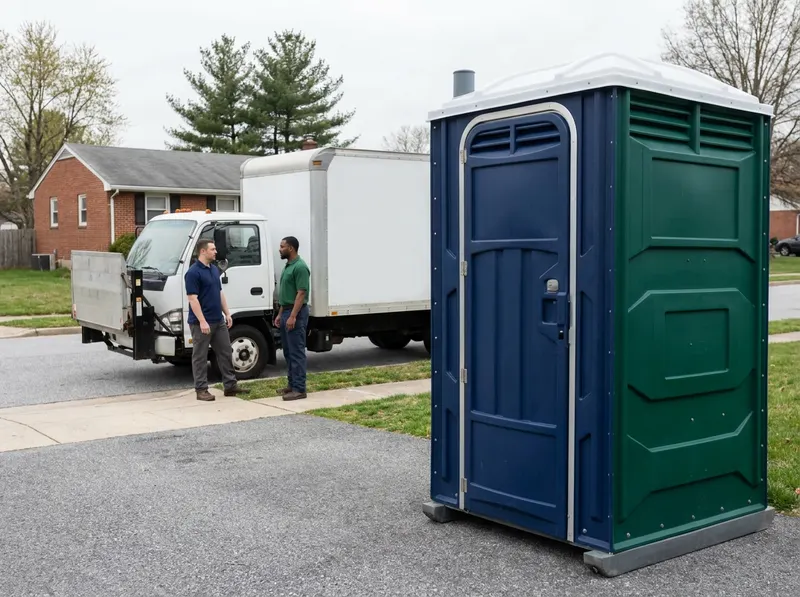
A standard unit needs roughly a 4-by-4-foot footprint and about 7.5 feet of vertical clearance, which is why placement — not price — is usually the real question in Baltimore. In Canton and Fells Point, the parking lane in front of a rowhouse is often the only flat pad available, and a sidewalk or street drop in Baltimore City generally requires a right-of-way permit from the city. We walk the site with you before booking and tell you plainly whether the unit fits, needs a permit, or belongs in the alley instead. Hampden side streets off Falls Road and the blocks behind The Avenue frequently work better as rear-alley drops, as long as the alley is clear of parked cars and low wires on delivery morning. Locust Point and Brooklyn lots are the easy end of the spectrum — open ground, room for the truck to swing.
The standard unit is the right fit when you need volume at a fair rate and nobody expects a sink inside the door. Construction crews near Remington and the Johns Hopkins medical campus run them for months at a time. Neighborhood cookouts at Patterson Park, 5K starts near Druid Hill Park, and driveway graduation parties in Roland Park and Highlandtown are all standard-unit jobs. The trade-off is honest: there is no flush and no plumbed handwashing inside the unit, so wedding receptions, catered tents, and food-vendor setups usually justify a flushing or trailer-style restroom instead, and any site with public attendance should plan for a wheelchair-accessible unit as well. If a guest count is borderline, we would rather add a second standard unit than watch a line form.
Quantity math is simple and worth doing before you book. One standard unit comfortably covers about 50 people for a four-hour event, or roughly 10 workers on a five-day work week with weekly service. Longer events, beer service, or hot July weekends in Federal Hill push that number down — alcohol roughly doubles usage. On job sites, we set the pump-out schedule to crew size rather than a default, because a weekly service on a 20-man site fills up by Thursday and an every-other-week service on a three-man remodel is money wasted.
Delivery in Baltimore City happens on a scheduled window, not a vague "sometime that day." We ask for the unit's spot to be clear of vehicles at drop-off, since a blocked parking lane in Mount Vernon or a car in the alley behind a Highlandtown rowhouse turns a ten-minute delivery into a rescheduled trip. Baltimore is an independent city, so permitting runs through city departments rather than a county office — we will tell you which situations need paperwork and which do not. Call (667) 218-4527 and we will get you a ballpark over the phone, then confirm the exact number on-site for free.
Every job gets a firm, written price after a free on-site visit.
Tell us about your standard porta potty rental job in Baltimore and we'll send a clear, written quote — usually the same day.
 Baltimore Porta Potty Rental Co.