The decision most Baltimore contractors actually face is monthly job-site rental versus a short weekend drop. If your crew is on site more than about ten working days, monthly with weekly service is the cheaper and…
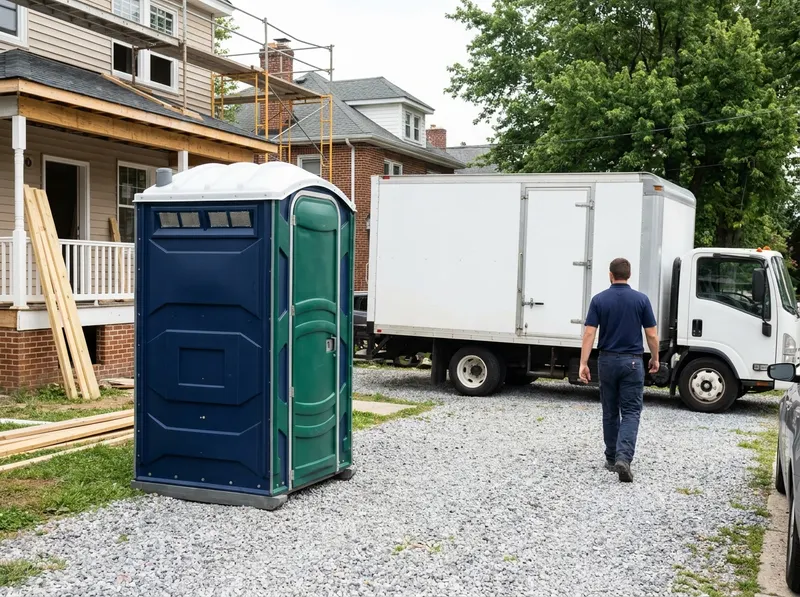
The decision most Baltimore contractors actually face is monthly job-site rental versus a short weekend drop. If your crew is on site more than about ten working days, monthly with weekly service is the cheaper and cleaner path — you pay one rate, the truck comes on a set day, and nobody on the crew is driving to a gas station on the clock. A short-term drop makes sense for a one-day pour, a punch-list day, or a demo push where the site closes right after. The trade-off is real: short-term costs less in total but more per day, and it puts you back on the phone every time the schedule slips. Baltimore schedules slip. Monthly rental with weekly service is the standard fit for framing, roofing, sitework, and full rowhouse rehabs.
Placement is where Baltimore jobs get interesting, and it's the part we plan first. A rowhouse gut in Remington, Highlandtown, or Canton usually has no front setback at all, so the unit either goes in the rear alley, in a permitted parking-lane spot, or inside the shell on the first floor slab — each of those changes how the service truck reaches it, and the hose reach is the limit, not the truck. Our driver needs roughly 25 feet of hose reach from where the truck can legally stop to the unit door. On Federal Hill and Fells Point streets, that often means staging the unit at the corner or against the party wall rather than mid-block. Locust Point and Brooklyn sites tend to have yard or lot space, which makes multi-unit setups and hand-wash stations easy. Larger sites near Hampden's mill buildings or off the Jones Falls corridor usually take a unit set back from the gate so deliveries and concrete trucks aren't swinging past it.
Permits matter on the tight blocks. Placement fully on private property — inside the fence, on the lot, in your own rear pad — generally does not require a city permit. Placement on a Baltimore City sidewalk, parking lane, or alley right-of-way typically requires authorization from the city, and rules differ block by block, so we'll tell you straight during the site visit whether we think you need one and what the application asks for. We'll also flag the practical stuff a permit won't fix: street-sweeping days, one-way alleys too narrow for the service truck, and residential blocks where a unit facing a neighbor's front window will generate a complaint by the second week.
For crew sizing, a common planning ratio on job sites is one unit per 10 workers with weekly service, scaled up if the crew is larger or the site runs long days. If your headcount jumps mid-project — say a subcontractor stack during rough-in — we can add a second unit or bump service to twice weekly without restarting your agreement. Hand-wash stations and hand sanitizer dispensers are available as add-ons where you want them for OSHA sanitation expectations or simply because the crew is eating lunch on site. If you need an ADA-compliant wheelchair-accessible unit for a public-facing or contract-required setup, ask when you call; those units need a wider, level approach, which is a real constraint on narrow city sites and worth sorting out before delivery day. Pricing quoted by phone is a ballpark; the exact number is confirmed on a free on-site visit once we've seen the access, the surface, and the service route.
Every job gets a firm, written price after a free on-site visit.
Tell us about your construction site porta potty rental job in Baltimore and we'll send a clear, written quote — usually the same day.
 Baltimore Porta Potty Rental Co.