The decision usually comes down to sinks versus sanitizer. Hand sanitizer stands are cheaper and fine for a backyard party in Roland Park or a small crew doing interior work. Once food is being handled — a taco cart at…
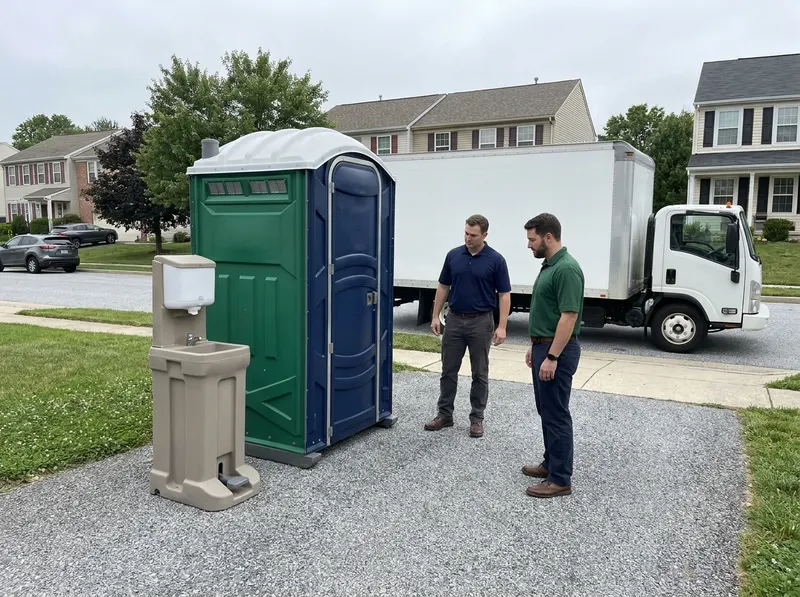
The decision usually comes down to sinks versus sanitizer. Hand sanitizer stands are cheaper and fine for a backyard party in Roland Park or a small crew doing interior work. Once food is being handled — a taco cart at a Patterson Park gathering, a pit beef setup at a Canton block party, volunteers plating food at a Locust Point fundraiser — Baltimore City health inspectors generally expect real handwashing with running water and soap where food is prepared or served, so a station with a foot-pump faucet is the safer call. Temporary food facility rules are set by the Baltimore City Health Department; tell us how many vendors you have and we'll help you figure out how many sinks that setup realistically needs before you file.
On construction sites, the trade-off is different. If you're already renting a standard portable toilet, adding a separate hand-wash station gives your crew a proper sink for the whole shift — useful on masonry, demo, and utility work in Remington and Highlandtown where hands get filthy long before lunch. If you've rented a flushing restroom trailer instead, that unit already has sinks inside, and a standalone station is usually redundant. We'll say so rather than sell you the extra piece.
Placement is where Baltimore gets particular, and it's the part we plan for first. Rowhouse blocks in Federal Hill and Fells Point leave almost no shoulder, so we look for a flat spot the delivery truck can reach without blocking a lane — a corner, a driveway apron, the mouth of an alley in Hampden, or a parking pad. A hand-wash station is lighter and narrower than a restroom unit, which helps on tight sidewalks, but it still needs level ground so the water drains toward the greywater tank instead of pooling at someone's feet. If the sink has to sit in the public right-of-way — sidewalk, curb lane, or a closed street — that placement may require a City permit, and we'll walk you through what applies to your block. We'd rather flag it early than have an inspector or a neighbor shut it down on event morning.
A few honest logistics. Standard stations run on cold water from an onboard tank; we don't advertise heated water unless a specific unit supports it, so ask and we'll tell you straight. Heavy use drains a tank faster than most people expect — a festival with several food vendors in Mount Vernon can go through a fill in a day, so we'll schedule a mid-event restock rather than leave you with an empty faucet. In December through February, freezing is the real risk on job sites in Brooklyn and along the water near Fort McHenry, so we'll talk through drain-down timing or a sanitizer alternative if the forecast makes a water unit impractical. Delivery windows are given as a window, and we call when the truck is close, so nobody stands around waiting on a curb.
Orders start at $250, and every quote is a ballpark until we've seen the spot. That's the whole point of the free on-site visit — measuring the approach, checking the grade, and confirming the number of stations before you commit. For portable toilets, restroom trailers, and multi-unit event packages, start from our Baltimore porta potty rental homepage and we'll build the whole setup on one order.
Every job gets a firm, written price after a free on-site visit.
Tell us about your hand-wash station rental job in Baltimore and we'll send a clear, written quote — usually the same day.
 Baltimore Porta Potty Rental Co.