The decision between a standard unit and a high-capacity holding tank unit comes down to traffic and access, not comfort. A standard portable restroom serving a crew of eight to ten usually needs weekly service. Push…
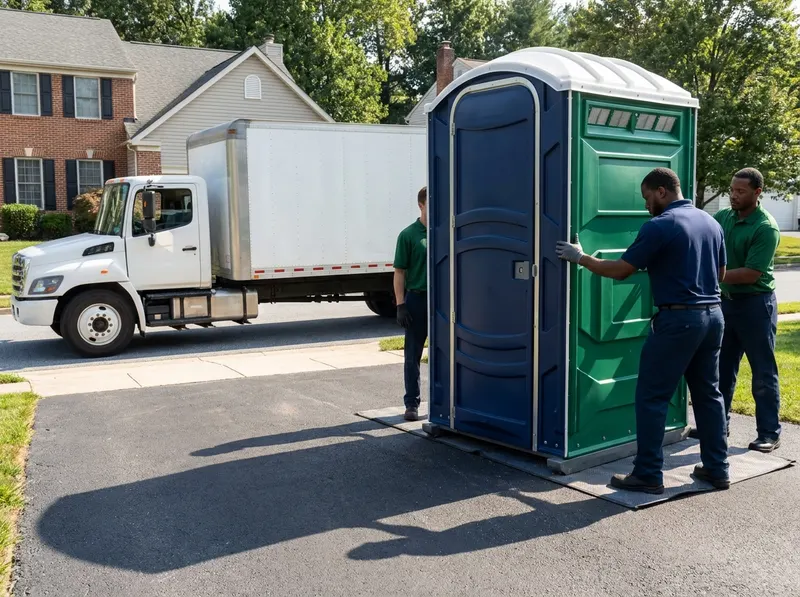
The decision between a standard unit and a high-capacity holding tank unit comes down to traffic and access, not comfort. A standard portable restroom serving a crew of eight to ten usually needs weekly service. Push that same unit to a 300-person block party or a two-shift crew and it fills before anyone gets back to it. The high-capacity tank buys you margin — more uses before the tank reaches its limit, which means fewer trucks on your street and less risk of a full unit on the busiest afternoon. The trade-off is honest: it costs more than a standard unit, it is heavier when loaded, and it is still one stall. If your problem is line length rather than tank volume, you need more units, not more capacity — we will say so on the walkthrough rather than upsell you into the wrong equipment.
Baltimore placement is where this unit needs the most thought, and it is the part most vendors gloss over. A loaded tank is heavy, so it wants firm, reasonably level ground — a paved parking pad, a driveway apron, or a compacted lot rather than soft turf after a rainy week. The unit also has to sit within hose reach of wherever our truck can legally stop, generally around 100 feet. On the tight rowhouse blocks in Canton, Fells Point, and Federal Hill, that usually means the parking lane or a rear alley off Aliceanna, Hudson, or Clement, and it means checking alley width and turning room before we commit to a spot. In Locust Point and Brooklyn, industrial yards give us room to work but often sit far from the gate, so we map the truck path first. Roland Park and Hampden driveways are frequently the cleanest option for long renovations, since the unit stays off the public right-of-way entirely.
Placement in a Baltimore City parking lane or on a sidewalk typically requires a right-of-way permit, and we tell you what the city asks for and coordinate placement around your approval timeline. Baltimore is an independent city, so the process runs through the city rather than a county office — worth knowing if you have worked events in Baltimore County. Because of that, we ask about permits early instead of showing up and improvising.
This unit earns its keep in specific Baltimore situations. Festival footprints in Patterson Park and Druid Hill Park often put restrooms hundreds of feet from any truck-accessible drive, so extra tank volume matters more than a shorter service interval. Trail and stream work in Gwynns Falls/Leakin Park has the same problem for weeks at a time. Street festivals along 36th Street in Hampden, Mount Vernon and Remington block events, and long weekend crowds near the Inner Harbor, Fort McHenry, and Oriole Park at Camden Yards all run heavy for two or three days straight, when getting a truck back through closed streets is unrealistic. For multi-day events we schedule the pump-out around your run-of-show, not ours, and we confirm the plan in writing before delivery. Long-duration commercial and healthcare-adjacent job sites, including work near Johns Hopkins Hospital and in Highlandtown, use these units to cut the number of service visits on a congested block. Call (667) 218-4527 and we will look at the site, confirm the ballpark, and put the unit on time, clean, exactly where needed.
Every job gets a firm, written price after a free on-site visit.
Tell us about your high-capacity holding tank unit job in Baltimore and we'll send a clear, written quote — usually the same day.
 Baltimore Porta Potty Rental Co.